
Note: This article’s content has been prepared and drafted with assistance of Claude Sonnet 5, but we also did the initial thinking and final writing in the end. This is our way to always ensure that everything we publish is still human-first, AI-second. This is also part of the Appendix section within our unconventional resume. You can download it via our profile.
Synopsis
We are building our Forge based upon a simple, stubborn belief: the best AI experience shouldn’t force us to think in a straight line just because a chat window happens to render that way. As a design engineer/architect, we treat cognition the way we treat any system we craft — spatially, with structure, zones, and weighted relationships between ideas, not a scroll of messages in chronological order. Cognitive Spatial Context (CSC) is our name for that shift: giving AI the ability to navigate a mind the way it currently navigates a page — with depth, association, and place, not just sequence. It’s the design thesis underneath everything else in Forge.
Introduction
Right now, most AI systems treat a conversation the way a diary treats a day — one entry after another, moving in a single linear direction. Ask something, get an answer, ask the next thing, and the whole exchange stacks into a single long-running chain. There’s no side room to step into, no way to hold two or more threads of thoughts near each other unless they happen to occur one after the other. Today’s AI has the capability to store context in the form of a single long-running thread, and without any lateral structure.
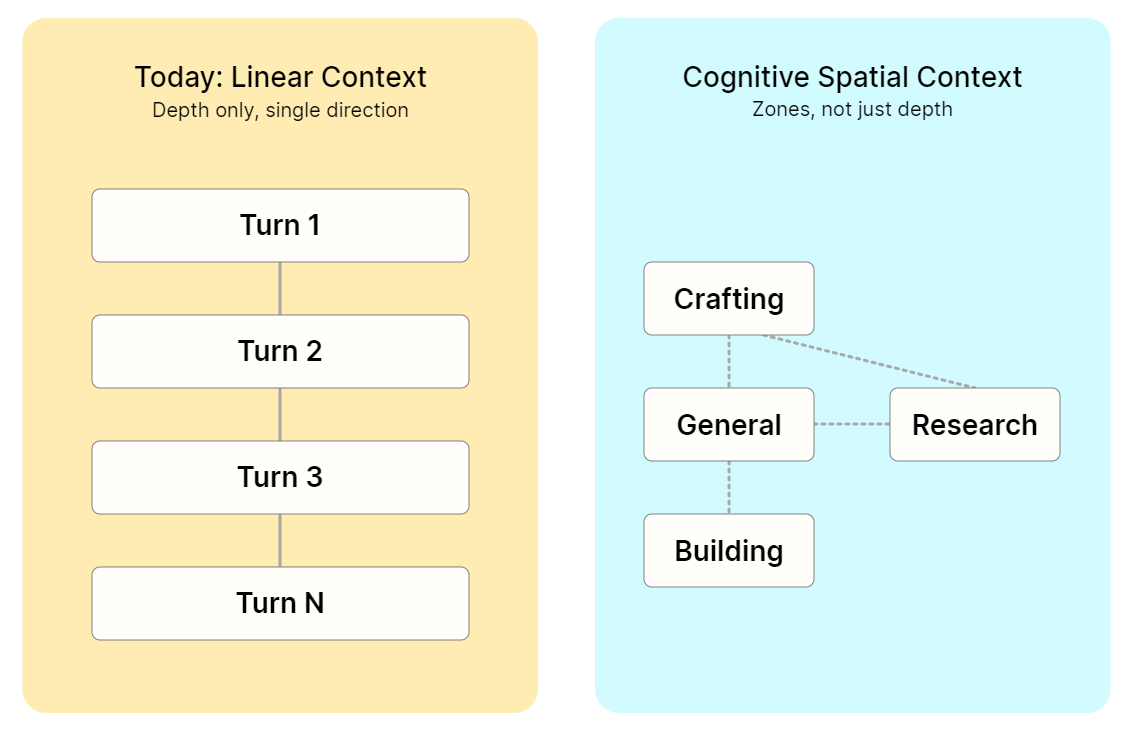
That’s the gap that Cognitive Spatial Context starts from. Not “how do we make the chain longer or smarter,” but a more basic question: why is a chain the shape we settled on in the first place? A mind doesn’t organize itself that way. We move between a research thread and a half-finished idea and a completed unrelated task in the same hour, and we don’t lose track of any of them — because we’re not holding them in a line, we’re holding them in a space, each with its own place we can return to.
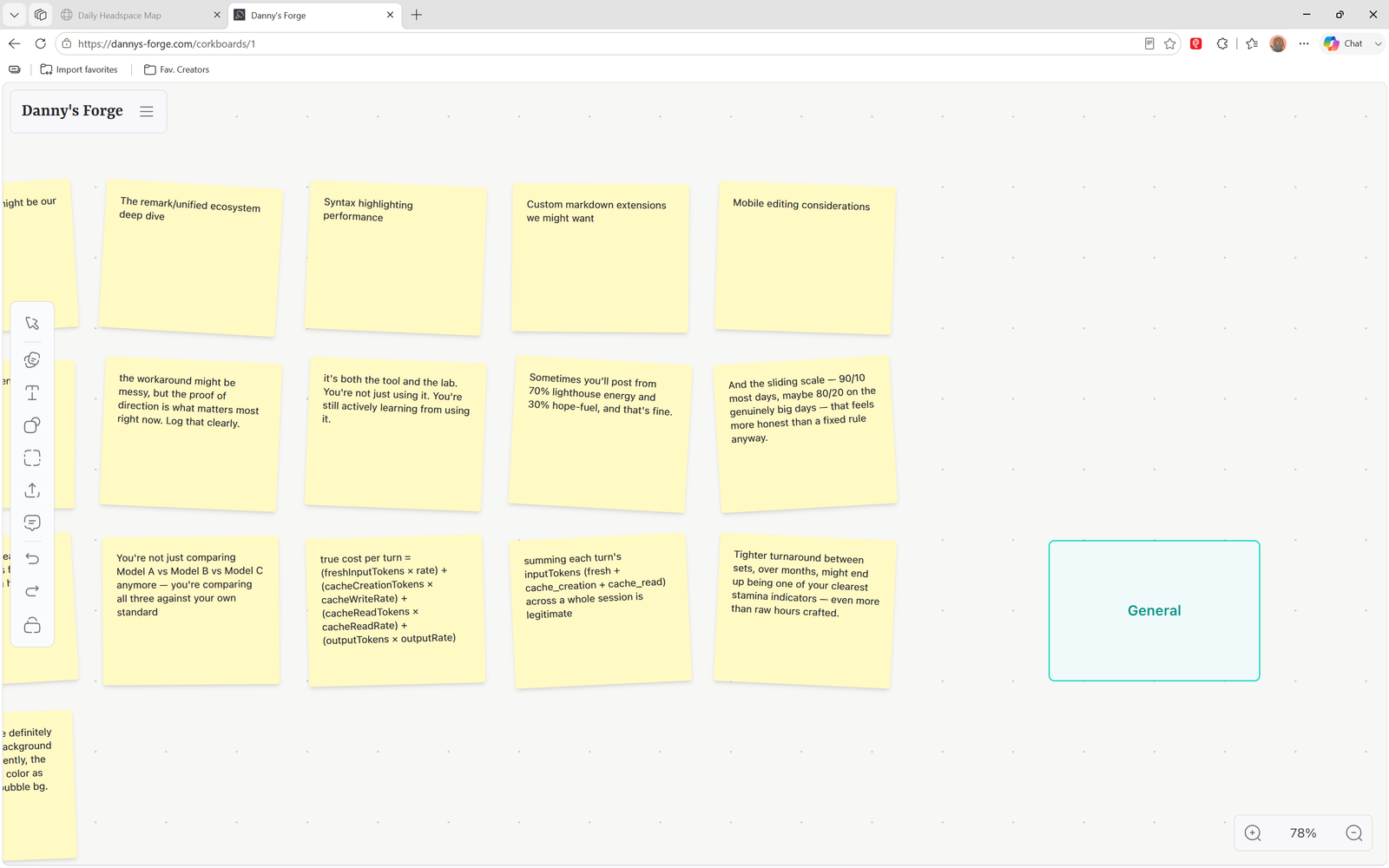
CSC is our name for building that same shape into how AI holds a session: a navigable mental space instead of a linear feed (context). It’s the design thesis underneath everything else in Forge — including two of its most direct expressions, the Corkboard and the 3D Knowledge Map.
Spatial Intelligence
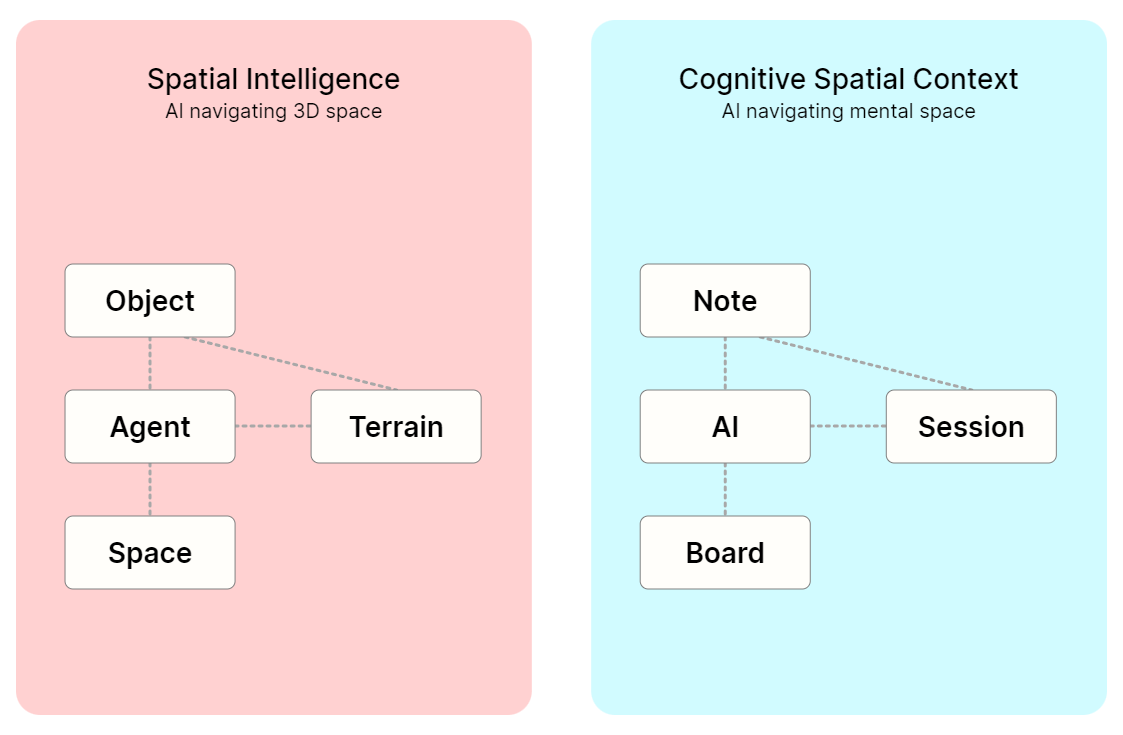
We did not arrive at this thesis in isolation, and we think it’s worth saying so plainly. Fei-Fei Li — the researcher behind ImageNet and now leading spatial intelligence work at World Labs and Standford HAI — has been making a related argument from a completely different direction: reasoning in three-dimensional physical space is AI’s next major capability gap, sitting alongside language intelligence rather than replacing it.
In practice, that thesis is showing up as things like Marble, World Labs’ navigable 3D world generation, and a wider push into robotics and simulation — systems built to understand objects, agents, and terrain as a real space to move through, not a flat description to parse.
We are not claiming any connection to that work, and we want to be clear about that boundary. What we do think is worth naming is that a well-funded, credible part of the field has independently converged on “spatial” as the frontier — in a domain that has nothing to do with ours. That’s not proof CSC is right. But it’s a signal we’re not reaching for a metaphor out of thin air.
Bringing Both Together
Set side-by-side, the parallel is direct: same diagnosis, two different domains. Spatial intelligence says today’s AI lacks the structure to reason about physical space — objects, agents, terrain, environment. CSC says today’s AI lacks the structure to reason about cognitive space — note, session, board, the shape of a person’s actual thinking. Different territory, same missing piece.
We want to be precise about what this is and isn’t. This isn’t a claim that our work and World Labs’ work are the same, or that one derives the other. It’s an independent convergence — two people looking at the same underlying limitation in AI systems, from opposite ends of what “space” can mean.
At Forge, that thesis becomes concrete in two places. The Corkboard is where it lives today — a thinking space built around zones and relationships instead of a scroll. The 3D Knowledge Map is where it’s headed — the fuller expression of navigating a mind the way you’d navigate a place.
Leave a Reply